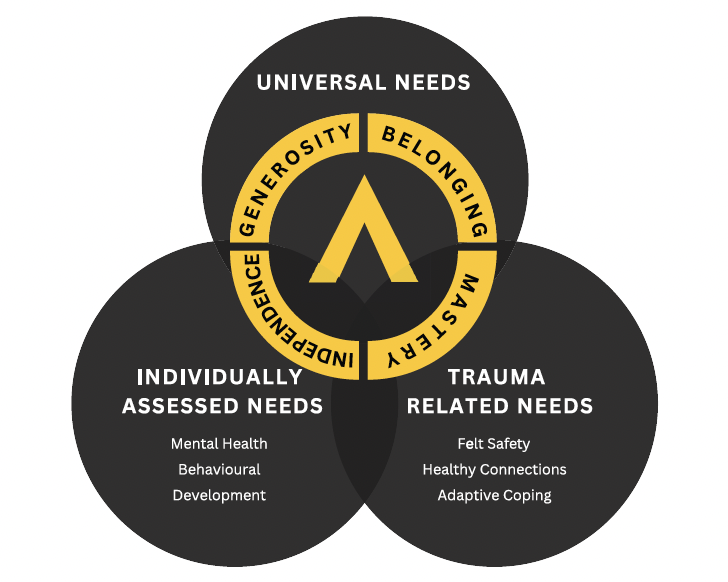
The Needs-Based Restorative Framework guides the work of Allambi Care’s staff and volunteers including Intensive Therapeutic (Residential) Care staff, foster carers, family support staff, caseworkers and clinicians. The framework is based on our commitment to respond to the multiple needs of people rather than requiring them to adjust to a pre-determined service model. It applies whether they are living in the community with families or peers or are being supported in out of home care. There are three core components of the framework. The central focus is on the normal and shared developmental needs of all people and the defining features of healthy growth as defined in the Circle of Courage.
This month we're exploring MASTERY for young people generally, with a focus on the importance of mastery for those living with disability next month.
When I was 11, I finally hit the magical 1,000,000 points in the Atari VCS game River Raid. I cheered in delight as my plane blew up, the score display turned to “!!!!!!” and the game was over (imagine that, these days). I can’t recall the number of hours I spent trying to reach that elusive target, the pain, the anger, or the arguments with my parents, but I do recall that score. I had worked out the pattern, changed my approach, stayed focused and finally beaten it. The feeling I had afterwards was about more than simply winning a game; I had mastered something that had previously been difficult.
Perhaps you remember learning to ride a bike, kicking a football properly, playing a song, drawing something you were proud of or even braiding your own hair for the first time. These are ordinary experiences, but they can be incredibly important. We learn something, practise it, eventually get it right and suddenly think, “I can do this.”
That is Mastery.
Within Allambi Care’s Needs-Based Restorative Framework (NBRF), Mastery is one of the four Universal Needs. It is about helping young people develop skills, confidence, competence and a sense of achievement, but it is also about something deeper; when we master something, we are building our belief in ourselves. We are developing a sense that we are capable, that our efforts are worthwhile and that we can overcome challenges and for young people in OOHC, those experiences can be particularly important.
Many young people have experienced adults telling them what they cannot do, being moved between environments, having opportunities taken away from them or experiencing repeated failure. Some may have developed a belief that they are not good at anything or that there is little point trying because they will probably fail anyway, while others may have become so used to adults doing things for them that they have never had the opportunity to discover what they can do themselves. This is where we, as Support Workers, have an important role.
Mastery is not about being perfect
Mastery does not mean that a young person must be the best at something. It is not about winning every game, getting every question right or producing a perfect result. It is about the process of learning something and gradually becoming more capable.
Think about how we learn anything ourselves. We rarely get it right the first time. I certainly didn’t plug River Raid into my games console and hit that score first time! I made mistakes, became frustrated, tried again (and again and again – just ask my mum!) until eventually I improved, but still hadn’t hit the big time. The same needs to be true for young people.
Sometimes, however, our natural instinct as adults is to step in and make things easier.
If dinner needs to be cooked, we cook it. If the young person's room is messy, we clean it. If they need to make a phone call, we make the call for them. If they are struggling with something, we take over because sometimes it’s just quicker and we know how to do it.
Our intentions are usually good, but there is a difference between helping a young person and doing something for them, and if we continually do things for a young person, they may never get the opportunity to experience that wonderful moment of realising, “I did that myself.”
Look for opportunities to teach
Imagine a young person wants to learn how to make spaghetti bolognese. We could simply make this Italian delight ourselves and put a plate in front of them. The immediate need has been met, but there has been little opportunity for the young person to learn. Where is the fun in that?!
Instead, we might make it together. We can pick the recipe together, get the ingredients, chop the onions, brown the mince and explain what we are doing and why. The next time, perhaps they do more of it while we take a step back and provide guidance. Imagine the feeling they will have when they dish up dinner for the team!
The important part is not the spaghetti bolognese; the important part is what the young person has gained from the experience.
They have learnt a skill, overcome challenges -- put a dessert spoon in your mouth when cutting the onions to stop the tears! -- and experienced success. They now know something they didn't know before. More importantly, they have evidence that they are capable of learning something new.
That experience can then transfer into other areas of their life, where small achievements can have a big impact. It’s sometimes easy to underestimate the importance of the small things, but they are so important.
For an adult, learning how to use public transport might seem straightforward, but for a young person who has never caught a bus alone, successfully getting to their destination can be a significant achievement. What about topping up their Opal card, reading a bus timetable, getting the correct bus, getting off at the correct stop, all of these tasks that appear so simple to us can similarly provide a sense of competence for our young people.
The same applies to interests and hobbies. Embrace the small wins! The skateboard trick that is finally landed, learning the guitar chords to the latest top hit, getting a ‘C’ grade instead of a ‘D’. We should not dismiss these things simply because they may not appear important to us, as these are opportunities for young people to experience persistence, problem-solving, frustration, progress and eventually success.
Sometimes Mastery is simply a young person discovering something they are good at, which can be incredibly powerful for their sense of self-worth. Who has ever told them they were good at anything? Remember when you were told that first time?!
What happens when we master something?
There is something quite satisfying about finally being able to do something that once seemed difficult. It gives us confidence, but it also changes the way we see ourselves, and I would argue this continues even as adults! We might move from thinking, “I can't do that,” to “I couldn't do that before, but now I can.” This shift matters. A young person who begins to see themselves as someone who can learn, improve and succeed may become more willing to attempt other challenges. Success in one area can create the confidence to have another go somewhere else.
This is why we should notice and celebrate progress, particularly when the young person has had to work hard to achieve it. Rather than simply saying, “Good job,” we can acknowledge what actually happened: “I’m so proud of you. You kept trying even when you were frustrated.” Comments like this help a young person recognise their own ability and effort.
Let young people struggle a little
One of the most important things we can do to support Mastery is to resist the urge to rescue young people from every difficulty. If something is safe and appropriate, it is okay for a young person to struggle; in fact, struggling is often part of learning.
We don't want a young person to become overwhelmed or feel abandoned, so our role is to provide support when they need it. But there is a big difference between saying, “I'll do it for you,” and saying, “Let's work out how you can do this.”
If my dad had taken that Atari controller off me and completed the game, I would not have had that amazing sense of achievement. I can still feel it now!
Preparing young people for life
Mastery also has a very practical purpose in OOHC. Young people will eventually leave our care and need to navigate adult life with increasing independence. They will need to cook, clean, manage money, communicate with services, maintain relationships, solve problems and make decisions. If we have always done these things for them, we may have made their lives easier in the short term but made the transition to adulthood harder in the long term, so everyday activities therefore become opportunities to build capability. The question for Support Workers is not simply, “How can I get this done?” but also, “What could this young person learn from this?”
Mastery is about believing, “I can”
When we think about Mastery, we should remember that it is not just about life skills or ticking off things a young person can now do. It is about helping them develop a positive relationship with themselves. It is that feeling we had as children when we learnt to ride a bike, scored the winning goal, completed the magic trick, or finally managed to juggle three tennis balls at once. Nobody had to tell us we were capable because we had experienced it for ourselves.
For young people in OOHC, we have countless opportunities to create those experiences. We can teach rather than take over, we can encourage rather than criticise, we can allow young people to try, make mistakes and try again. Most importantly, we can notice the moments when they realise that something which once seemed impossible is now something they can do.
And you will know, as you will see it in their face, the look of astonishment, the open eyes, the circled lips, the scream of fulfilment, and I bet you will mirror the behaviour!
Mastery is not about being perfect. It is about building the confidence to look at a challenge and think, “I don't know how to do this yet, but maybe I can learn.”
It helps us build resilience because we begin to understand that difficult things can become possible with time, effort and persistence. We learn that failure does not have to be the end of the story.
And perhaps that is what Mastery is really about: knowing that life will sometimes feel like 999,999 points, but having the confidence to keep going until the screen finally turns to!!!!!!
Neil Richardson - Trainer, Learning and Development