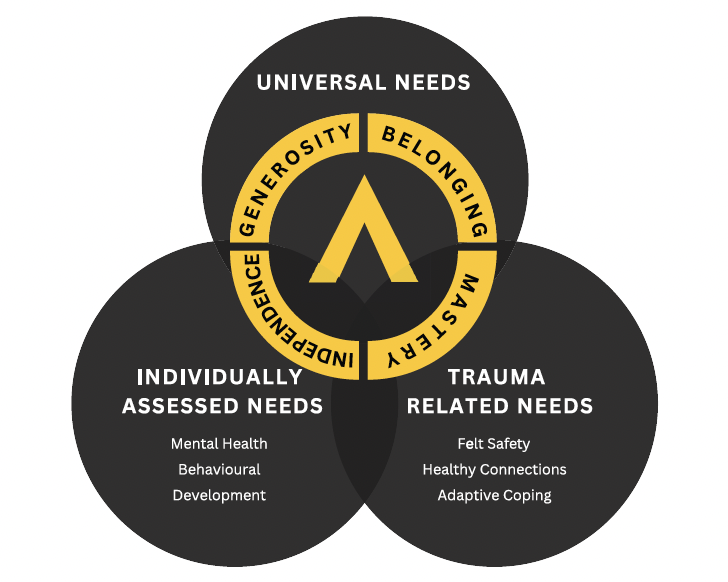
The Needs-Based Restorative Framework guides the work of Allambi Care’s staff and volunteers including Intensive Therapeutic (Residential) Care staff, foster carers, family support staff, caseworkers and clinicians. The framework is based on our commitment to respond to the multiple needs of people rather than requiring them to adjust to a pre-determined service model. It applies whether they are living in the community with families or peers or are being supported in out of home care. There are three core components of the framework. The central focus is on the normal and shared developmental needs of all people and the defining features of healthy growth as defined in the Circle of Courage.
This month we're exploring BELONGING.
Imagine standing in a group of people and wondering if you really fit in.
Think back to school. Perhaps there was a time when teams were picked for lunchtime football. One by one, names were called until only a few people remained. Maybe you were one of the last chosen. Maybe you remember pretending it didn't matter, while quietly wondering why no one had picked you.
Or perhaps you've walked into a room where everyone else already knew each other. Conversations were flowing, people were laughing, and you felt like an outsider looking in.
Most of us have experienced moments like these. They may have only lasted a few minutes or a few hours, but we remember how they made us feel.
Now imagine if that feeling wasn't occasional. Imagine if it was part of everyday life.
For many of the children and young people supported by Allambi Care, belonging is not something they take for granted. It is something they long for.
Many have experienced separation from their families, disrupted relationships, trauma, neglect or abuse. Some have attended multiple schools, lived in several homes or struggled to maintain friendships because their lives have been anything but stable. Others may have experienced rejection by adults who were supposed to love and protect them.
Every one of those experiences can quietly reinforce a painful question: "Where do I belong?"
Belonging is the first of the four Universal Needs within Allambi Care's Needs-Based Restorative Framework because without it, everything else becomes harder. It is difficult to learn when you don't feel accepted. It is difficult to become independent when you don't believe anyone wants you around. It is difficult to be generous when you've rarely experienced genuine connection yourself.
As support workers, it is easy to focus on the tasks that need completing during a shift. Medication needs to be administered; Meals need to be prepared; Appointments need to be attended, and documentation needs to be written.
All of these things matter.
But what children and young people often remember most is how they felt when they were with you.
Consider a school assembly or parent-teacher evening. Other children arrive holding mum's hand or chatting with dad. Our young person arrives with a support worker. While that support worker may be caring, professional and supportive, the young person is often painfully aware that they are different.
Think about birthdays when invitations don't come.
Think about Christmas when classmates talk about family traditions that your young person has never experienced.
Think about wearing inexpensive shoes while friends compare the latest brands. To an adult, they are just shoes. To a young person trying desperately to fit in, they can feel like a billboard announcing, "I'm different."
Sometimes belonging is challenged in much smaller ways: A young person asks if you will watch their football game; they want to show you a drawing they've spent an hour creating; they ask if you can sit with them while they eat; they ask the same question for the third time because they simply want the conversation to continue.
These moments can seem ordinary.
To the young person, they are often asking something much bigger than the words they're saying.
They may actually be asking:
"Do I matter to you?"
"Will you stay?"
"Am I important enough for your time?"
This is why relationships sit at the heart of therapeutic care. Belonging is not created through grand gestures; it grows through hundreds of ordinary interactions that communicate safety, acceptance and value.
It is remembering how they like their Milo. It is noticing they've had a difficult day before they say anything. It is cheering louder than anyone else at their school sports carnival. It is displaying genuine interest in the music they listen to, the games they play or the things that make them laugh. It is keeping your promises, arriving when you say you will and following through, even on the little things.
Every one of these moments tells a young person:
"You matter."
"You are welcome here."
"You belong."
This doesn't mean we lower expectations or avoid boundaries. In fact, consistent boundaries help create belonging because they communicate predictability and safety. Young people are more likely to accept guidance from adults who have first earned the right through connection. As support workers, we may never completely erase the losses a child or young person has experienced.
We cannot replace parents. We cannot undo trauma. We cannot rewrite their past, but every shift allows us to write a different chapter.
Every respectful interaction, every shared laugh, every kept promise and every moment of genuine connection helps challenge the belief that they are unwanted, unimportant or alone.
When children and young people experience belonging, they begin to trust. When they trust, they begin to regulate. When they regulate, they begin to learn. When they learn, they begin to grow. Belonging is not simply about feeling included. It is about helping a child or young person believe, perhaps for the first time in a very long time, that they are worthy of love, worthy of care and worthy of a place where they are accepted exactly as they are.
That is why belonging is the foundation of the Needs-Based Restorative Framework. And that is why the relationship you build may be one of the most powerful interventions you will ever provide.
So What Can You Do Today?
The good news is that belonging isn't something that takes months to build. Every shift presents opportunities to strengthen it. You don't need to organise expensive outings or create extraordinary experiences. More often than not, belonging is built in the ordinary moments.
Learn something new about your young person and remember it for next time.
Use their name, ask about the football game they mentioned last week, notice when they're quieter than usual and check in. Invite them to help cook dinner rather than simply preparing it for them, sit with them instead of standing over them and celebrate their successes, no matter how small.
Keep the promises you make, even if it's simply remembering to bring the card game you said you'd play, knocking before entering their bedroom, including them in decisions that affect their day. Listen without immediately trying to solve the problem, share appropriate laughter, be genuinely interested in what matters to them, even if it isn't something you personally enjoy.
Most importantly, be consistent.
Many of our children and young people have experienced adults coming and going throughout their lives. They have learned not to trust words because words have often been broken. What builds belonging is not what you say once, but what you do repeatedly.
At the end of every shift, ask yourself one simple question:
"What did I do today that helped this young person feel they belonged?"
If you can answer that question every time you finish work, you are already doing one of the most therapeutic things a Support Worker can do.